
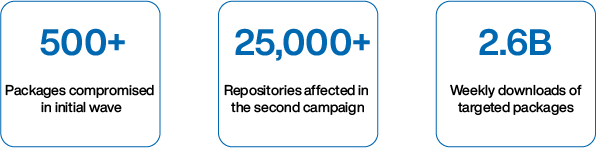
In Frank Herbert's Dune, the Shai-Hulud are giant sandworms. They're sources of immense power and constant threat to anyone crossing the desert. The malware campaign that borrowed this name lived up to it: a self-replicating worm that compromised over 500 npm packages, stole credentials from thousands of development environments, and left security teams worldwide scrambling to respond.
This isn't another routine vulnerability disclosure. The Shai-Hulud campaigns, which started in September 2025 and escalated through November, showed us something we hadn't quite seen before (at least, not widespread). One compromised maintainer account cascaded into millions of affected downloads. Trusted dependencies turned into credential theft vectors in minutes. And the automation we built to ship software faster had suddenly been weaponized.
Most organizations still aren't ready for this. Not because defensive strategies don't exist, but because supply chain security became the new "zero trust", a term for everything, which has become meaningless. At best it's something you do for compliance, not something you actually operationalize.
That approach is no longer viable.
Understanding the Attack
Before we can defend against this, we need to understand what made it work. The individual pieces weren't new. Phishing, credential theft, code injection—we've seen all of this before. What made Shai-Hulud different was how it chained them together, exploiting the trust relationships baked into how we build software.
Initial access was straightforward: targeted phishing against maintainers of popular npm packages. These are often individual developers or small teams, and they control libraries that get downloaded millions of times a week. Compromise one account and you can push a malicious package version to the registry. Every downstream project pulls it automatically.
But Shai-Hulud didn't stop there. The malware was self-replicating. Once it landed, it scanned for credentials: npm tokens, GitHub PATs, cloud API keys. It used those to compromise other packages from the same developer. Each infected package became another propagation point. The worm spread on its own, exponentially, without the attackers lifting a finger.

What made it clever wasn't the code itself—it was the architecture. Modern software development runs on a web of implicit trust. We trust package registries to serve what maintainers publish. We trust maintainers to not go rogue. Our CI/CD systems trust whatever's in the dependency tree. Production trusts whatever comes out of the build. Compromise any single node in that chain, and suddenly those trust relationships become attack paths.
What Actually Works
Defending against attacks like this takes work across multiple fronts. In our experience, there are five areas that matter most. None of them is sufficient on its own.
1.Dependency Governance

It starts with actually knowing what's in your software. You can't secure what you can't see. That means maintaining real-time inventories of all dependencies, not just the ones you directly import, but the entire transitive tree. When CISA drops an alert about a compromised package, you need to know within hours whether you're affected. Not weeks.
You also need policies about what's allowed into your codebase in the first place. Who maintains it? How active is the community? Has it been deprecated? What's its security track record? A package with one maintainer who hasn't pushed an update in two years is a very different risk than one with an active team and regular releases.
On the practical side: pin your dependencies to known-good versions, use lockfiles religiously. Finally while auto updates are the preferred way to go, keep an eye on them.
2.Build Pipeline Hardening

Shai-Hulud specifically went after lifecycle scripts, the code that runs automatically when you install a package. In a lot of organizations, that code runs in build environments with access to production credentials, deployment keys, internal systems. The same convenience that makes CI/CD so useful is exactly what makes it dangerous when a dependency goes bad.
Hardening this requires a few interconnected changes. Disable or heavily restrict lifecycle scripts in your build environments. Put egress controls in place so build systems can't reach arbitrary external endpoints. The malware exfiltrated to webhook.site—no legitimate build needs to talk to that domain. Use short-lived, tightly scoped credentials for automation instead of long-lived tokens with kitchen-sink permissions.
Much like many organizations "assume breach", you should assume malicious code will occasionally make it into your build pipeline. Design systems that limit what it can do when that happens.
3.Identity and Access Hardening

This one's simple in principle, harder in practice: get MFA on every developer account that has publishing rights. Package registries, code repos, cloud infrastructure. TOTP apps are better than nothing, but they're still vulnerable to phishing attacks. Hardware security keys are the way to go if you can swing it.
Beyond MFA, you need to apply least privilege to all your automation. GitHub tokens shouldn't stick around forever with full repo access. npm tokens shouldn't let you publish to every package a developer maintains. Cloud credentials shouldn't give admin access across the board. Scope each credential to exactly what it needs and nothing else.
GitHub has already announced they're limiting automation tokens to seven-day lifetimes and deprecating legacy auth methods.
Security awareness training doesn't work, so minimize time on that (there's still a compliance box to check), and utilize actual technical controls where you can.
4.Detection and Monitoring

You need to monitor for weird behavior, not just known-bad signatures. Unexpected outbound connections from your build environment. Strange publishing patterns on your packages. Workflow files showing up in repos without anyone reviewing them.
In the case of Shai-Hulud, the attackers created repos with obvious naming patterns and added workflow files that stood out if you were watching for them. Organizations with decent detection caught the exposure early. Those without it found out the hard way.
Just as important: you need to be able to move fast when something triggers. That means having actual tested processes for auditing your dependency tree, rotating credentials, and rebuilding from a known-good state.
5.Organizational Resilience

No defense is perfect, and you have to plan for that. Build the muscle to recover quickly. Have tested—not theoretical, tested—procedures for rotating credentials, purging caches, rolling back dependencies. Make sure your incident communication channels don't depend on systems that might themselves be compromised. Run exercises that prove you can actually execute under pressure.
Plug into the broader security community. The organizations that responded fastest to Shai-Hulud were the ones in information-sharing networks that gave them early warning. Not necessarily the ISAC's, but there are plenty of information sharing networks out there.
The Regulatory Angle
If the security case doesn't move you, there's always the regulatory one. SEC rules now require material cybersecurity incidents to be disclosed within four days. The EU's Cyber Resilience Act kicks in late 2027 and will require vendors to demonstrate supply chain security as part of CE conformity. A compromised dependency isn't just an engineering problem anymore. It's a board-level compliance issue.
Organizations that treat these requirements as box-checking exercises will keep scrambling every time something like Shai-Hulud happens. Those that actually build the capability will be in a better spot, both for compliance and for protecting their operations.
Where to Start
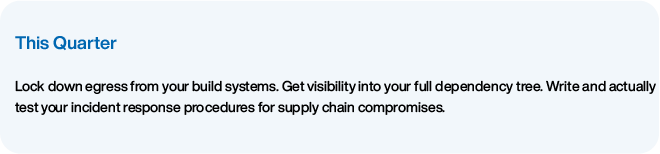
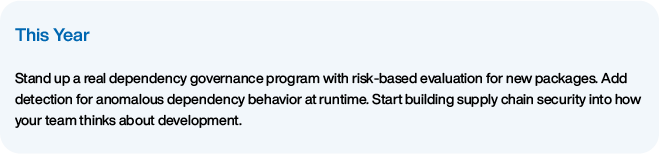
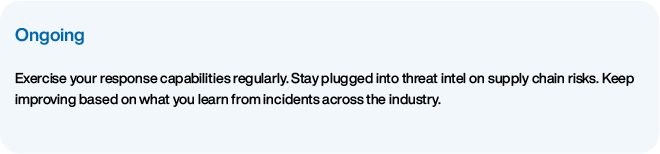
All of this can feel overwhelming, especially if you're dealing with years of technical debt and dependency sprawl. Here's a rough sequence that makes sense for most organizations:

Bottom Line
Shai-Hulud proved that supply chain attacks have gone from theoretical to real. Self-replication, credential theft, destructive fallbacks when exfiltration fails—this is what the threat looks like now. It's not an outlier.
The response also showed what's possible when the community moves fast. Registries, researchers, and affected companies coordinated to contain this faster than a lot of people expected. That kind of collective response matters.
If you treat supply chain security as a one-time project, you'll keep getting caught out. If you build it as an operational discipline—visibility, hardening, credential hygiene, detection, response muscle—you'll handle the next incident better.
References
List of affected packages: https://github.com/gensecaihq/Shai-Hulud-2.0-Detector