
The Basics
A penetration test is a controlled security assessment where trained professionals attempt to break into your systems.
They use the same tools and techniques as real attackers. They probe networks, applications, and infrastructure. They look for weaknesses and exploit vulnerabilities.
The difference? They document everything they find and show you how to fix it before criminals discover the same issues.

Why This Matters
You can't fix what you don't know is broken.
Most organizations think they're secure. They've got firewalls. Antivirus software. Security policies. Compliance checkboxes ticked.
Then a penetration test reveals the truth. A misconfigured server. An outdated application. A default password no one changed. Employee credentials for sale on the dark web.
Real attackers will find these issues. The question is whether you find them first.
The average data breach costs companies $4.45 million according to IBM's latest research.
Penetration Test vs. Vulnerability Scan
This is the most important distinction to understand. They're not the same thing. Not even close.
Vulnerability Scanning
An automated process that identifies potential vulnerabilities. A scanner runs against your systems and generates a list of known issues.
Scanners are fast. They're consistent. They catch obvious problems. But they can't think. They can't chain vulnerabilities together. They can't determine if something is actually exploitable in your specific environment.
You get a long list of findings. Many are false positives. Some are real but low risk. A few might be critical. But you won't know which is which without manual verification.
Penetration Testing
A hands-on approach where professionals actively try to exploit vulnerabilities. They use the same techniques as real attackers. They think like attackers. They don't just find vulnerabilities—they prove they can be exploited.
Testers combine multiple low-risk issues to achieve high-impact access. They test business logic flaws that scanners miss. They verify findings manually. They provide context about actual risk.
You get a prioritized list of real vulnerabilities with proof of exploitation and business impact assessment. No guessing about what matters.

What Gets Tested
Penetration tests cover different attack surfaces. Each requires specialized knowledge:
- Network infrastructure. Servers, firewalls, routers, wireless networks. External perimeter testing and internal lateral movement. How far can an attacker pivot once inside?
- Web applications. SQL injection, cross-site scripting, broken authentication. The OWASP Top 10 vulnerabilities. Business logic flaws that automated scanners miss completely.
- Cloud environments. AWS, Azure, GCP configurations. Misconfigured storage buckets. Overprivileged IAM roles. Container escape scenarios. Multi-tenant boundary violations.
- Social engineering. Phishing campaigns, pretexting, physical access attempts. Your employees are part of the attack surface whether you like it or not.
- Mobile applications. iOS and Android apps. Insecure data storage, weak encryption, API vulnerabilities. Certificate pinning bypasses. Jailbreak detection evasion.
- APIs. REST and GraphQL endpoints. Authentication bypass. Rate limiting failures. Mass assignment vulnerabilities. Excessive data exposure through API responses.
The scope depends on what you need tested and where your actual risk lies. Not everyone needs everything tested at once.
Four Reasons You Need This
1. Discover vulnerabilities first. Hidden flaws exist in every system. A controlled test reveals them before criminals exploit them during an actual attack.
2. Avoid breach costs. The $4.45 million average includes incident response, legal fees, regulatory fines, lost business, and reputation damage. Testing costs far less than cleaning up after a breach.
3. Meet compliance requirements. HIPAA, PCI DSS, SOC 2, and other frameworks require regular penetration testing. You can't maintain certification without it.
4. Demonstrate security commitment. Customers ask about security practices. Partners want assurance before integrating systems. Investors evaluate security posture during due diligence. Testing provides credible proof.
What Most Vendors Won't Tell You
After testing everything from banking apps to power plants, we've seen patterns. Here's what the industry doesn't want you to know.
Most "Pen Test" Reports Are Scanner Output
The majority of penetration test reports are 90% automated scanner findings with 10% manual testing. Vendors run Nessus or Burp Suite, clean up the output, and call it a penetration test.
Real testing requires manual work. Chaining vulnerabilities. Testing business logic. Verifying exploitability. That takes time and expertise most vendors don't have.
Guaranteed Results Are a Red Flag
Vendors who guarantee they'll find vulnerabilities are either lying or incompetent. Professional testers know they might find nothing if security is genuinely solid.
The inability to find vulnerabilities isn't a testing failure—it's a security success. Vendors who promise results have incentives to manufacture findings.
Price Differences Aren't About Scope
The difference between a $15K pen test and a $50K pen test usually isn't the scope. It's who's doing the work.
Junior testers following a checklist cost less. Experienced practitioners who've broken into Fortune 500 companies cost more. You get what you pay for.
Different Types of Penetration Tests
Black Box
Testers know nothing about your systems. They start from scratch, just like a real attacker would. This shows what an outsider could discover and exploit.
White Box
Testers get full access to documentation, credentials, and source code. This finds deeper vulnerabilities that take time to discover. More thorough, but less realistic as an attack scenario.
Gray Box
A middle ground. Testers get some information, like basic user credentials. This simulates an insider threat or a compromised employee account. Most common in practice.
Common Questions
How long does it take?
Most tests run one to three weeks. Simple applications might take a few days. Complex environments with multiple systems can take months. It depends on scope.
Will it break things?
Good testers are careful. They use production-safe techniques. But there's always some risk. That's why you agree on rules of engagement upfront. Most organizations test in staging environments first.
How much does it cost?
Web application testing typically runs $15K-$30K for 2-3 weeks. Network infrastructure assessments start around $25K. Mobile app testing ranges from $20K-$40K. Cloud environment reviews fall between $18K-$35K.
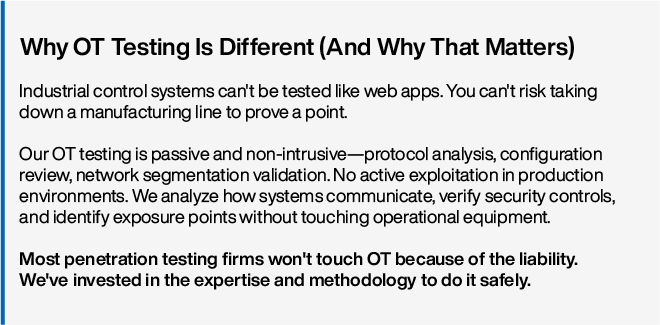
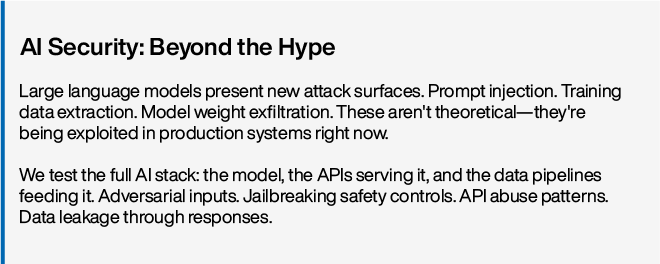
Enterprise-wide testing covering multiple attack surfaces can exceed $100K. Most engagements land between $20K-$50K. OT and AI testing require specialized expertise and typically cost more.
How often should we test?
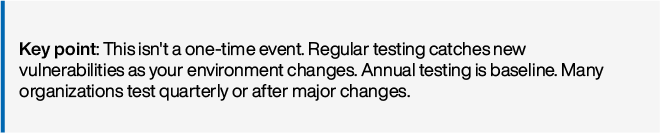
At least annually. But test more often if you're making changes. New application release? Test it. Cloud migration? Test it. Major infrastructure update? Test it.
What happens after?
You get a detailed report. It lists every vulnerability found, ranked by severity. It explains how each could be exploited. And it provides specific remediation guidance.
Fix the critical issues first. Then work through the rest based on risk. Many vendors offer retesting to confirm fixes work.
How It Actually Works
Professional penetration testing follows a structured methodology. Five phases that build on each other:
Phase 1: Planning and Scoping. Define what gets tested. Set rules of engagement. Identify critical systems. Agree on testing windows. This prevents surprises and ensures everyone's aligned.
Phase 2: Reconnaissance. Gather information about your environment. Passive and active scanning. Map the attack surface. Identify potential entry points. This is where testers think like attackers planning an assault.
Phase 3: Exploitation. Attempt to exploit discovered vulnerabilities. Test attack chains. Prove vulnerabilities are real. Document successful compromises. This is the hands-on testing phase.
Phase 4: Post-Exploitation. See how far access can be extended. Test lateral movement. Identify what data could be accessed. Determine potential business impact. This shows what a real attacker could achieve.
Phase 5: Reporting. Document all findings with evidence. Rank vulnerabilities by risk. Provide remediation guidance. Present results to technical and executive audiences. This is where findings become actionable intelligence.
How to Evaluate Penetration Testing Vendors
Not all penetration testing companies are equal. Not even close. Here's how to separate real expertise from sales pitches:
🚩 Red Flags
"We guarantee we'll find vulnerabilities"
This incentivizes manufactured findings. Good testers hope to find nothing—it means your security is solid.
"Our report includes 200+ pages"
Length ≠ value. Most of that is scanner output and filler. You want actionable findings, not page count.
"We're the cheapest option"
You're paying for expertise. If they're 40% cheaper, ask where corners are cut. Junior testers? Automated tools only?
"We use proprietary tools"
Translation: automated scanners with custom branding. Real testers use industry-standard tools (Burp Suite, Metasploit, etc.).
"We can complete this in 2 days"
Comprehensive testing takes time. Unrealistic timeframes mean they're rushing or only running scanners.
✅ Green Flags
"Here's our methodology and sample report"
Transparency about process and deliverables. They should walk you through their five-phase approach and show you what you'll actually get.
"We'll scope this based on your risk profile"
Custom approach, not cookie-cutter packages. They ask questions about your business, critical assets, and threat model.
"Our team includes [specific certifications + real experience]"
OSCP, CREST, GPEN matter. But so does "we've tested 50+ FinTech apps" or "we specialize in OT environments." Experience > certifications.
"We provide remediation support during/after testing"
Findings are useless if you can't fix them. Good vendors help you understand and remediate vulnerabilities, not just list them.
"Let me connect you with past clients in your industry"
References matter. A vendor who tests healthcare apps might not understand industrial control systems or AI/LLM security.
What to Ask Vendors
- What's your methodology? (Should be more detailed than "we follow OWASP")
- Who will actually perform the testing? (Ask for their background and certifications)
- Can I see a sample report from a similar engagement?
- What happens if you find a critical vulnerability mid-test?
- Do you provide retesting after we remediate findings?
- How do you handle scope creep or unexpected findings?
Bottom line: Choose a vendor you can work with repeatedly, not just for a single engagement. Security isn't a one-time purchase. The best relationships span years.
Why Annual Penetration Testing Isn't Enough Anymore
Here's the problem with penetration testing as it's traditionally sold:
- You test in Q1. Get findings in Q2. Remediate in Q3. By Q4, your environment has changed 50+ times.
- New code deployed. New cloud resources spun up. New APIs exposed.
- Your last pen test report is already outdated.
That's why we built Incenter.
Continuous security testing that runs between formal penetration tests. Automated reconnaissance. Attack surface monitoring. Vulnerability correlation. Think of it as your security team's eyes on infrastructure changes in real-time.
Annual pen tests catch the big issues. Incenter catches what changes in the 364 days between tests.
SEE HOW INCENTER WORKS →