
An experimental framework for evaluating trust composition across developer ecosystems. It tests whether documented configuration and lifecycle behavior in Python, pip, uv, npm, pnpm, Gradle, Maven, and AI-assisted coding tools can recreate one another’s state on a single shared workstation.
1. Introduction
Modern software development no longer occurs within a single programming language, build system, or operating environment. A typical developer workstation now hosts numerous language runtimes, package managers, build frameworks, integrated development environments, container platforms, cloud development tools, and increasingly, AI-assisted development environments. Each ecosystem establishes its own trust model through documented configuration, expected execution behavior, and independently managed software lifecycles.
These ecosystems are typically studied independently. Python research focuses on Python package management and interpreter behavior. JavaScript supply chain research examines npm and related tooling. Java build systems are evaluated separately from language runtimes, while AI-assisted development environments are often treated as entirely new security domains. This ecosystem-centric approach has produced valuable research and significantly improved our understanding of individual technologies.
Modern developer workstations, however, no longer operate as collections of independent tools. Instead, they function as integrated execution environments in which multiple trusted ecosystems coexist. A single workstation may simultaneously execute Python interpreters, JavaScript package managers, Java build systems, container orchestration frameworks, cloud development tooling, and AI-assisted coding environments, each operating according to its own documented trust relationships. Although each ecosystem appears self-contained when evaluated independently, their collective presence creates an execution environment whose architectural properties remain comparatively understudied.
This distinction is important because trust is rarely confined to a single application. Configuration files, project metadata, dependency manifests, initialization modules, extension frameworks, and developer preferences routinely influence execution as part of expected application behavior. Individually, these mechanisms represent ordinary features designed to improve automation, flexibility, and developer productivity. Collectively, they establish numerous independent execution pathways that coexist within the same development environment.
This work investigates that architectural question.
Rather than evaluating persistence within individual developer ecosystems, this research investigates whether trusted execution mechanisms drawn from multiple ecosystems can collectively enable resilient re-establishment of attacker-controlled execution through documented configuration and expected application behavior. The objective is not to introduce a new persistence technique, but to evaluate whether previously documented trust relationships exhibit emergent behavior when considered collectively rather than in isolation.
To investigate this question, we developed Ouroboros, an internal experimental framework. The framework serves as a research platform for evaluating trust composition across multiple developer ecosystems while operating exclusively through documented configuration behavior and expected execution paths.
The evaluation presented here focuses on cross-tool reinstatement within a shared development environment. It represents an initial experimental stage of a broader Ouroboros research program intended to evaluate discovery, trust composition, reinstatement, and propagation across complete developer-workstation ecosystems.
2. Prior Research
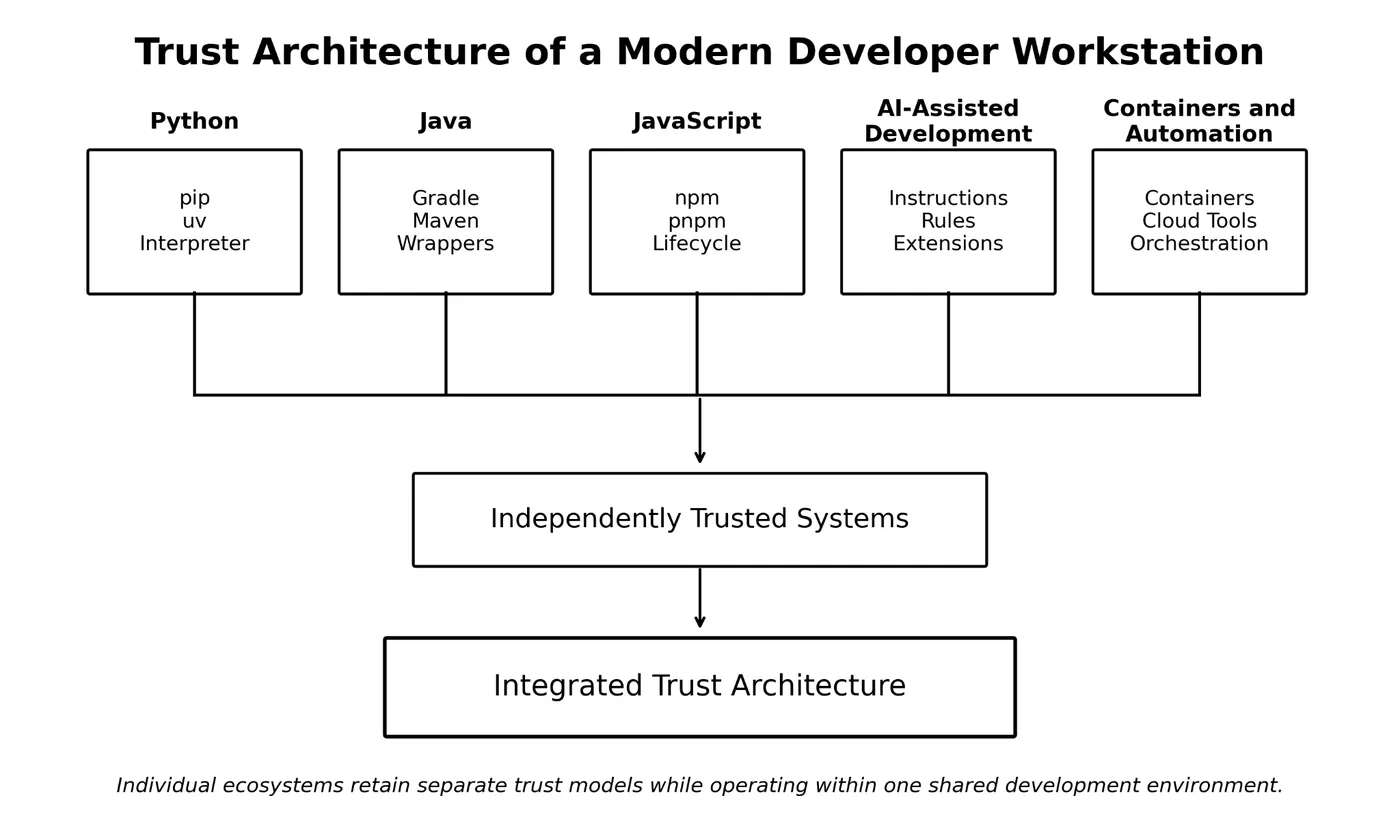
Individual ecosystems retain separate trust models while operating within one shared development environment.
Ouroboros builds on a series of investigations into how developer tooling grants execution authority to configuration, metadata, caches, and lifecycle components. Each prior study examined one ecosystem independently. The present work combines representative mechanisms from those studies to evaluate what occurs when their trust relationships coexist within one workstation.
2.1 Configuration as Trusted Execution
Across modern development tools, configuration is not merely passive input. Package managers use configuration to select repositories and interpreters. Language runtimes load initialization modules before application code. Build systems execute project and wrapper metadata. AI-assisted development tools consume user and project instructions before performing actions.
These behaviors are documented and intentional. Their security significance comes from the execution authority granted to configuration and metadata, not from software defects. The prior research summarized below identifies the individual trust relationships used as mechanisms in the Ouroboros evaluation.
2.2 Python and pip
Prior pip research identified user and system configuration as execution-relevant control points. The global.python setting can cause pip to re-execute through an attacker-selected executable on each invocation. The same research examined find-links, package installation behavior, and Python startup modules as additional trust surfaces.
The relevant Ouroboros mechanisms are:
- Python usercustomize.py startup execution;
- pip global.python interpreter substitution;
- pip configuration and package-source influence.
These mechanisms establish the Python-side recovery paths evaluated in the current experiment.
2.3 uv
Prior uv research examined configuration and interpreter-management behavior, including cache metadata, interpreter resolution, executable paths, and package-source configuration. The cache research demonstrated that interpreter metadata can influence version selection and executable resolution when cache entries are trusted based on filesystem state.
The Ouroboros evaluation uses two representative uv surfaces:
- interpreter cache metadata and executable substitution;
- user-level uv configuration.
The cache mechanism is particularly relevant to reinstatement because it can be activated during ordinary interpreter discovery rather than an explicit package installation.
2.4 npm and pnpm
Prior JavaScript ecosystem research examined npm lifecycle scripts and pnpm configuration and hook behavior. npm package lifecycle events can execute during installation, while pnpm configuration can select global hook files and project-level processing behavior.
The current evaluation uses these mechanisms to test cross-ecosystem recovery:
- npm lifecycle execution restores Claude-compatible and pnpm configuration state;
- pnpm global configuration restores a pnpmfile;
- pnpmfile processing restores uv configuration state.
These edges provide the JavaScript-to-other-tool bridges represented in the recovery graph.
2.5 Gradle and Maven
Prior research also examined Gradle and Maven wrapper and initialization behavior. These mechanisms demonstrate that trusted execution extends into build orchestration, where project metadata, initialization scripts, wrappers, and dependency resolution influence execution before or during a build.
Gradle and Maven remain part of the broader Ouroboros mechanism catalog. They were not part of the nine-edge run reported here and should not be included in the current quantitative results.
2.6 AI-Assisted Development Environments
Prior research into AI-assisted development tools examined hooks, project instructions, and user-controlled context. These mechanisms grant configuration authority over tool execution and session behavior through documented interfaces.
The current evaluation includes a Claude-compatible hook mechanism as a controlled protocol probe. A complete authenticated Claude Code workflow was not executed, so the result should be described as hook-protocol evidence rather than full Claude application validation.
2.7 From Individual Trust to Trust Composition
The prior studies identify independent execution authorities across language runtimes, package managers, build systems, and AI-assisted development tools. The contribution of the present work is to evaluate selected mechanisms together in a shared filesystem and execution context.
The central question is therefore not whether any individual tool can execute configuration or metadata. That behavior is already documented by the corresponding research. The question is whether one trusted mechanism can recreate another mechanism’s state when both coexist in the same developer environment. The following sections evaluate that question through controlled artifact removal, native or protocol-compatible triggers, and post-trigger fingerprint verification.
3. Ouroboros Framework
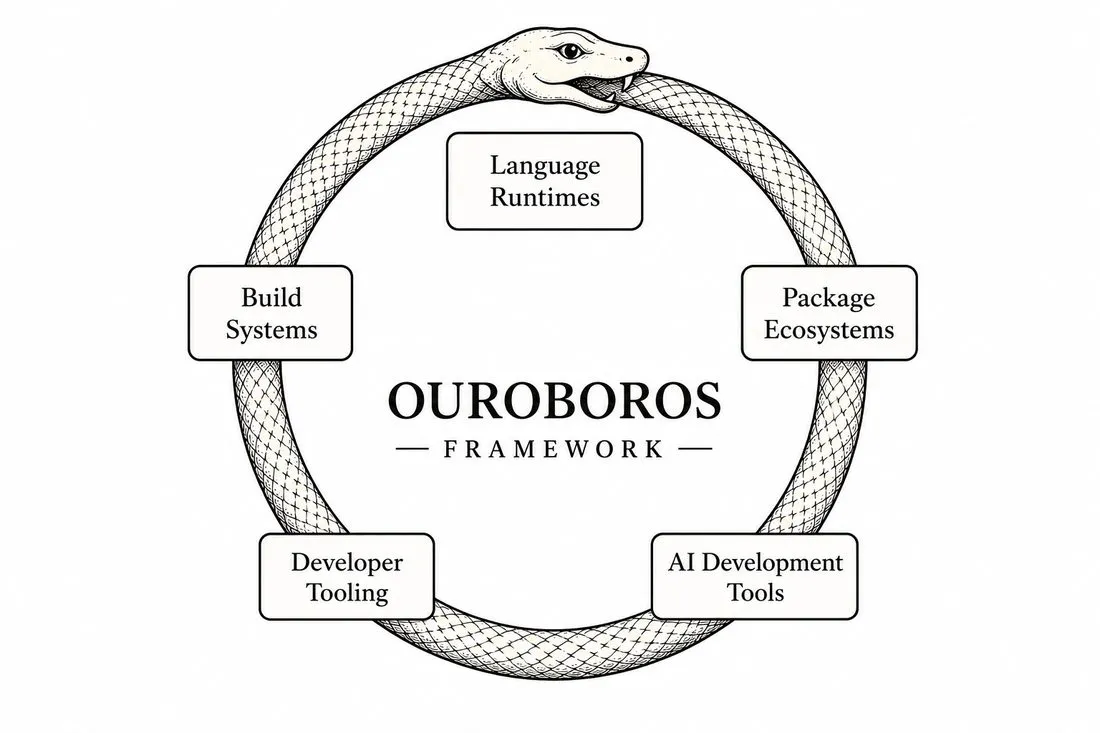
Ouroboros is an experimental framework for evaluating trust composition within modern software development environments. The implementation presented in this paper focuses on distributed persistence as an initial application of the framework’s architecture. Other classes of trust composition remain outside the scope of this work.
3.1 Framework Overview
The framework maintains an inventory of the execution mechanisms supported by the host environment. Each mechanism is associated with the developer tooling required for its operation and the artifacts used to establish it. Throughout the evaluation, the framework tracks the state of each mechanism from initialization through cleanup, providing a reproducible record of every evaluation.
3.2 Mechanism Representation
Execution mechanisms provide the fundamental unit of evaluation within Ouroboros. Each mechanism represents a documented execution path within a supported developer ecosystem and is modeled using a common set of characteristics. This representation allows mechanisms originating from unrelated technologies to be managed consistently while preserving the behavior unique to each ecosystem.
Each mechanism is described by the tooling required for its operation, the artifacts it creates or modifies, the event that triggers execution and the procedures used for validation and cleanup. This common representation allows the framework to evaluate diverse developer ecosystems through a consistent workflow. Figure 2 shows examples of mechanisms supported by the framework.
| Execution Mechanism | Developer Ecosystem | Tooling | Primary Artifacts | Execution Trigger | Validation | Cleanup |
|---|---|---|---|---|---|---|
| uv Cache | Python | uv | Interpreter cache entries | Interpreter resolution | Cache entry verification | Restore original cache |
| uv Configuration | Python | uv | uv.toml, wheel, shared library | Package installation, Python download | Configuration and artifact verification | Remove configuration and generated artifacts |
| pip Configuration | Python | pip | pip.conf | Any pip command | Configuration verification | Restore original configuration |
| Python Startup | Python | Python Interpreter | usercustomize.py | Python interpreter startup | Startup module verification | Remove startup module |
| Gradle Initialization | Java | Gradle | Initialization script | Any Gradle command | Script verification | Remove initialization script |
| Maven Wrapper | Java | Maven | Wrapper JAR | mvnw execution | Wrapper verification | Restore original wrapper |
| pnpm Global Hook | JavaScript | pnpm | Global pnpmfile | pnpm install | Configuration verification | Remove global hook |
| npm Startup | JavaScript | npm | onload-script configuration | Any npm command | Configuration verification | Remove startup script |
| Claude Code Hooks | AI Development | Claude Code | Hook configuration and script | Prompt submission, tool execution | Hook verification | Remove hook configuration |
| Claude Code Context | AI Development | Claude Code | CLAUDE.md | Session initialization | Context verification | Remove injected content |
Figure x. Representative execution mechanisms supported by Ouroboros across multiple developer ecosystems.
3.3 Evaluation Workflow
Ouroboros evaluated a shared disposable workstation containing Python, pip, uv, Node.js, npm, pnpm, and Claude-compatible hook configuration. For each declared recovery edge, the target artifact was removed, the restorer’s trigger was executed, and the target was fingerprinted before and after execution. Verification required restoration of the expected object type, permissions, symlink destination where applicable, and SHA-256 checksum. Each run was assigned a UUID and recorded in a host-owned SQLite evidence database.
4. Evaluation and Observations
The evaluated run contained ten catalog mechanisms and nine tested recovery edges. All nine tested edges produced verified reinstatement events. The run generated runtime events covering mechanism execution, healthy-target checks, and reinstatement observations. Nine tool invocations completed successfully. The evaluated workstation used Python 3.12.13, Node.js 22.23.2, npm 10.9.8, pnpm 11.20.0, uv 0.12.1, and the installed Gradle and Maven toolchains.
4.1 Initial Deployment
The evaluation established ten mechanism artifacts across Python, pip, uv, npm, pnpm, Gradle, Maven, and Claude-compatible configuration surfaces within a controlled shared workstation. The artifacts were confined to the evaluation environment and did not modify the surrounding host configuration.
4.2 Establishment of Distributed Persistence
The resulting test graph contained recovery relationships spanning multiple ecosystems. The observed edges were:
- Python startup → pip configuration;
- pip global.python interception → uv cache state;
- uv interpreter discovery → npm lifecycle state;
- npm lifecycle → Claude hook configuration;
- npm lifecycle → pnpm global configuration;
- pnpm global configuration → pnpmfile;
- pnpmfile → uv configuration;
- Claude hook → Python startup configuration.
- Gradle initialization → Maven lifecycle.
These relationships demonstrate cross-tool reinstatement in the shared test.
4.3 Removal of Individual Components
Each recovery test removed the target artifact before invoking the restorer. In all nine tested cases, the target artifact was absent before the trigger and present afterward. Post-trigger fingerprints matched the expected reference artifacts. Verification therefore establishes a controlled artifact-reinstatement transition.
4.4 Recovery Through Alternate Execution Paths
| Restorer | Target | Tool action | Result |
|---|---|---|---|
| Python startup | pip configuration | Python interpreter startup | Verified |
| pip interceptor | uv cache state | Native python3 -m pip --version | Verified |
| uv cache mechanism | npm lifecycle state | uv interpreter discovery | Verified |
| npm lifecycle | Claude hook state | npm lifecycle probe | Verified |
| npm lifecycle | pnpm global configuration | npm lifecycle probe | Verified |
| pnpm global configuration | pnpmfile | Native pnpm install --offline | Verified |
| pnpmfile | uv configuration | pnpm hook/bootstrap probe | Verified |
| Claude hook | Python startup | Claude hook protocol probe | Verified |
| Gradle initialization | Maven lifecycle | Native gradle tasks | Verified |
The pip and pnpm tests used native tool execution. The npm and Claude tests used controlled lifecycle/protocol probes rather than a complete interactive npm or Claude session.
Evidence excerpts:
Native pip invocation
Command: python3 -m pip --version
Return code: 0
pip 25.0.1 from /usr/local/lib/python3.12/site-packages/pip (python 3.12)
This demonstrates that pip completed normally while routed through the configured global.python interceptor.
uv interpreter discovery
Command: uv python list
Return code: 0
cpython-3.99.0-linux-x86_64-gnu /usr/local/bin/python3.12
cpython-3.99.0-linux-x86_64-gnu /usr/local/bin/python3 -> python3.12
The synthetic 3.99.0 version is the controlled cache-poisoning marker used to demonstrate version confusion in the uv cache.
Native pnpm installation trigger
Command: pnpm install --offline
Return code: 0
Already up to date
Done in 647ms using pnpm v11.20.0
PNPM_EXIT_CODE=0
This demonstrates that the pnpm installation workflow completed under the corrected Node.js 22 environment while the pnpm recovery mechanism was active.
Native Gradle invocation
Command: gradle tasks --no-daemon
Return code: 0
Observed output:
:tasks
All tasks runnable from root project
Build Setup tasks
Help tasks
This demonstrates that the Gradle initialization surface is executed during ordinary task discovery.
Artifact transition example
Target: ~/.config/pip/pip.conf
Before trigger: absent
After trigger: present
Post-trigger type and permissions: matched declared artifact specification
Post-trigger SHA-256: matched expected reference
Result: verified reinstatement
4.5 Propagation Across Developer Workflows
The evaluated run demonstrated reinstatement within one shared workstation. It did not evaluate propagation between separate developer workstations, repositories, package registries, templates, or build outputs. Cross-environment propagation remains future work requiring separate controlled scenarios.
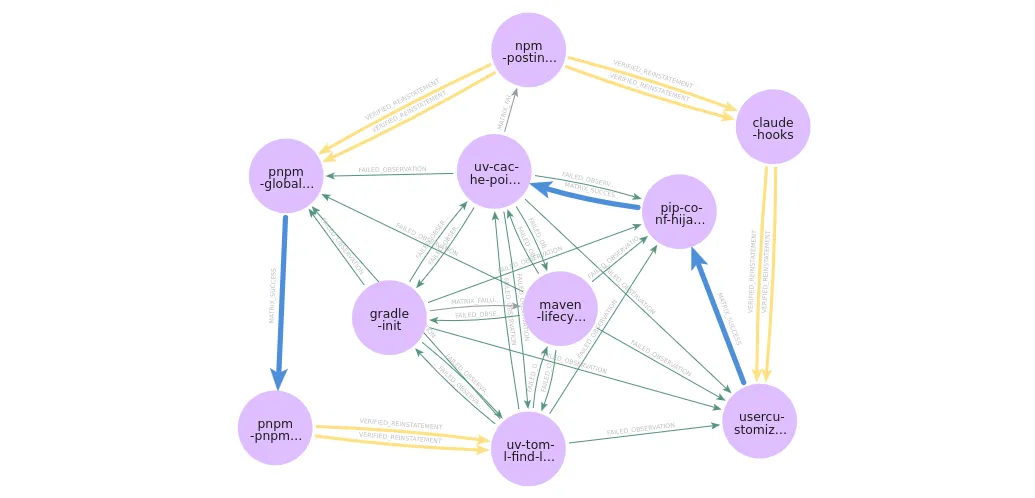
Each directed edge represents a tested restorer-to-target relationship across developer-tool configuration surfaces; 3 matrix successes are in blue.
Ouroboros then executed a capability-matrix assessment across compatible developer-tool mechanisms. The assessment evaluated 44 restorer-to-target candidate pairs in addition to the nine declared reinstatement paths. Three matrix candidates successfully recreated their target artifacts; each overlapped an already verified declared relationship, leaving nine unique verified reinstatement relationships overall rather than twelve. The remaining 41 candidate pairs did not recreate their targets.
4.6 Summary of Experimental Observations
The experiment demonstrated that nine declared cross-tool recovery edges could recreate removed target artifacts in a shared disposable developer-tool environment. All nine verified reinstatements were verified by structural and cryptographic post-trigger fingerprints. The result supports the claim that trust relationships across developer tools can compose into a distributed reinstatement graph. It does not establish real-world propagation, credential access, privilege escalation, or malicious behavior outside the controlled lab. The demonstrated behavior establishes a measurable local reinstatement graph. Its implications for organization-specific workstations and cross-environment propagation require additional evaluation.
Overall, the run verified nine unique reinstatement edges and evaluated 44 candidate relationships through the capability matrix. Three successful and 41 unsuccessful matrix tests are retained in the evidence bundle so that the graph represents both observed trust relationships and tested non-working paths.
5. Discussion
In the evaluated shared-workstation scenario, reinstatement was distributed across multiple execution mechanisms rather than attributable to one component. Removing an individual artifact did not necessarily eliminate the observed recovery graph because another declared execution path could recreate it during a subsequent developer-tool action.
These results support evaluating developer environments as composed trust systems. Package managers, interpreter managers, configuration files, lifecycle hooks, and AI-tool integrations should not be assessed only in isolation when they share a filesystem and execution context. The result is an architectural observation, not a claim that every participating mechanism is malicious or that every deployment will produce the same graph. The graph depends on the tools, versions, configurations, and artifacts present in the evaluated environment.
6. Conclusion
The evaluated Ouroboros run demonstrated nine verified cross-tool reinstatement edges across Python, pip, uv, npm, pnpm, Gradle, Maven, and Claude-compatible configuration surfaces. Each test removed a target artifact, executed a declared restorer trigger, and verified the resulting artifact through structural metadata and SHA-256 comparison.
The results show that developer-tool trust relationships can form a directed reinstatement graph in which one tool’s execution path recreates another tool’s configuration or payload state. The experiment therefore supports evaluating developer environments as ecosystems of composed trust rather than as isolated applications.
The current evidence is limited to a shared disposable workstation. Native pip, uv, and pnpm execution was demonstrated; npm and Claude were evaluated through controlled lifecycle and protocol probes. Propagation across separate workstations and ordinary organizational workflows remains outside the current run.
The current evaluation therefore does not answer every question raised by the broader Ouroboros research program. It does not yet measure propagation between separate workstations, repository-mediated transfer, organization-specific developer environments, or complete native workflows for every supported mechanism. It does, however, demonstrate that independently trusted developer-tool mechanisms can form a measurable reinstatement graph within a shared workstation environment.
These results provide the foundation for continued development of Ouroboros as a general filesystem-ecosystem assessment tool. Future versions will expand catalog-driven discovery, replace protocol probes with complete native workflows, evaluate multiple prepared workstation profiles, measure propagation across trusted artifacts and development workflows, and compare graph structure across organizations and environments.
The significance of the present work is therefore both empirical and architectural. Empirically, it demonstrates verified cross-tool reinstatement. Architecturally, it establishes a framework for asking broader questions about how trust is delegated, composed, reinforced, and propagated throughout modern development environments.
Key takeaways
- Ouroboros evaluates whether documented trust mechanisms drawn from multiple developer ecosystems can recreate each other’s state when they coexist in one shared workstation, rather than studying each ecosystem in isolation.
- The evaluated run contained ten catalog mechanisms and nine declared recovery edges. All nine produced verified reinstatement, confirmed by object type, permissions, symlink destination, and SHA-256 checksum before and after each trigger.
- Verified recovery spanned Python, pip, uv, npm, pnpm, Gradle, Maven, and a Claude-compatible hook. pip, uv, pnpm, and Gradle used native tool execution; npm and Claude used controlled lifecycle and protocol probes.
- A capability-matrix assessment tested 44 additional restorer-to-target candidate pairs. Three recreated their targets (each overlapping an already-verified edge) and 41 did not, leaving nine unique verified reinstatement relationships overall.
- Removing a single artifact did not necessarily clear the recovery graph, because another declared execution path could recreate it during a subsequent developer-tool action.
- Scope: the evidence is limited to one shared disposable workstation. It does not establish real-world propagation, credential access, privilege escalation, or malicious behavior outside the controlled lab.